

You’re Doing Social Media Wrong! Get Expert Social Media Marketing Tips Here With Isaac Mathews

When people think of social media marketing, they think that the best way to be successful is to post a lot. That’s not wrong, but if you only have two followers, you’ll go nowhere. It’s always best and more time-efficient to just run ads. Learn more about social media marketing and entrepreneurship with Chris D. Roberts and his guest Isaac Mathews. Isaac is a master social media marketer and the CEO of Growing Pains Marketing. Discover his story on how he took the leap of faith out of corporate America to start his own business. Find out why it’s better to work for yourself rather than someone else. Learn how to do social media marketing correctly today!
—
Listen to the podcast here
You’re Doing Social Media Wrong! Get Expert Social Media Marketing Tips Here With Isaac Mathews
Charging Forward Crew, we’re excited to have Isaac. He is a social media master. He runs Growing Pains Marketing. We’re going to get started with our first question as we always do. How do you view the word success? What comes to mind when you think about it? Success means different things to different people. It can be about money, business, personal health or relationships. When you hear the word success, what comes to mind for you? What are your thoughts in general?
A picture of Chris Roberts comes to mind. That’s how I define it. It’s something I’ve thought about over the years quite a bit. It’s something that has morphed over the years. When I was younger, some guy pulled up in a Lamborghini with a beautiful woman in the passenger seat. It’s like, “That guy is successful.” The older I’ve gotten, the more I’ve realized that success is different for everyone, which is why you opened with that question because it’s going to be a little bit different. It’s not like everyone has got a dictionary definition. It depends on the person, but for me, it’s the ability to live a life on your terms and that’s truly meaningful to you.
You come up with what is that measurement for yourself. Stephen Hawking said, “A life of purpose is purposing to have a life.” It’s some circular reasoning, but the idea was that you invented a purpose for yourself. For me, it’s being able to live life on my terms. Freedom is pretty important. Maybe that’s somewhere on Maslow’s Hierarchy of Needs. It’s being able to be free on business. I can do whatever I want. I can take off on Monday and cancel all my meetings. If I don’t like a client, I can fire them. If I don’t like someone that works for me, I don’t have to work with them anymore. It’s pretty amazing. That’s what it is for me. It’s freedom, essentially.
When you say freedom, freedom also means different things to different people. It’s interesting because we will dive into your business a little more here. You mentioned, “I have the freedom to choose which clients I work with. I have the freedom to go to work and put in 20 hours, 8 hours or whatever it may be.” Freedom is not so much freedom when you own a business, but it’s your freedom to choose.
It’s that freedom to make the decisions every day and enjoy the life I want to live. Let’s say you have children. You want to spend time with them in the middle of the week versus, “I’ve got a 9:00 to 5:00. I can’t get away.” Your definition of success, to a certain extent, would be having the freedom to choose and live life on your terms, business and personal.
There’s that book So Good They Can’t Ignore You. It’s all about finding the right career for you. It’s not necessarily what you’re passionate about but what you’re good about and what makes money. What he talks about a lot is, “Happiness in your profession has a lot to do with your ability to decide what you’re going to do. Do you have any artistic licenses?”
“Do you have to do the tasks as you’re told to do them? Can you decide the best way to do that project? Do you have to follow a five-step process?” Being able to do the work in the way that I want to do the work is important. I loved my last corporate job and my boss, but he would call me up and be like, “I need you in California in two weeks.” It’s like, “What if I don’t want to go to California in two weeks?” I don’t have to deal with that anymore. It’s nice.
Isaac talked about freedom. When you work for someone, you have to follow their guidance. It’s like, “I need you to do this by 4:00 or 2:00.” That’s great, but oftentimes, you don’t have the freedom to build out those creative juices, make mistakes, explore and challenge yourself. Oftentimes, you got to get out because you can’t have any overtime. You punch the clock and leave, but maybe you had something going on.
You’re like, “I want to stick around and do this,” but you can’t get paid for it and it’s not your company. You got to get out the door and go. The next day, you come in at 8:00 and there’s a whole pile of initiatives. You never get a chance to explore, work on things and try new things. I read a book a while back about 3M Imation. It might have been Good to Great or Built to Last. It’s one of those two.

Social Media Marketing: Entrepreneurs don’t want to work on another man’s dream. They won’t let them get that special part of their soul that stores all their creative juice. That’s only reserved for them.
They referenced how they took a small area and allowed employees to go in, play with things, experiment, and try to create for twenty minutes a day. Out of that came things like tape, sticky notes and things that we couldn’t live without for the most part or wouldn’t want to live without. A lot of those things came from employees on their schedules. The twenty minutes was their schedule.
It gave them that freedom. Some great things came out of that. That’s just one isolated incident. There are many. What I want you to take away from what he said is that it’s important when you have that mindset that you are set free so that you can then go out and break things, fix things and make things on your terms because there’s a brilliance that comes out of that freedom.
That’s what a lot of entrepreneurs yearn for. Unfortunately, most of us learn that you have to almost go to work with two full-time jobs now that you are your own boss. Eventually, that subsides. It is your two full-time jobs. I’m being facetious here, talking about 80 hours a week. Most entrepreneurs can attest that they will work those hours. It’s your time and freedom to go out and create.
When you say two full-time jobs, do you mean the side hustle plus the main job?
Isaac went out on his own and started a company. He thought he was going to go be his own boss, work fifteen hours a week and tell everyone what to do. Instead, he realized that he was working 80 hours instead of 50 hours at what was his job where he was dictated to. Most entrepreneurs realize, “I put in a ton of hours in the beginning, but they’re my hours.” There’s a different vibe that comes with that.
You’re working for yourself. I remember when I quit my corporate job. I was on the phone with the VP and the CMO. They were over me and trying to get me to stay. The name of the meeting was Convince Isaac to Stay. I was on the phone with them on a Zoom call. I was like, “It doesn’t make sense to me to work this hard for someone else.” They just gave me blank stares. For them, it makes sense. They have had a lot of success and they’re up the corporate ladder. Good for them. That’s one path. For me, it’s like, “I’m not going to work this hard on another man’s dream.”
You don’t get that special part of my soul that stays up at night thinking about something and all my creative juice. That’s reserved for me. A lot of people need to think about that. People in corporate jobs work 50, 60, 70, to 80 hours. They’re working tons of hours. If you were able to carve off some of that or worked half as hard for yourself, where could you be even if you only have an extra few hours a day? I built a business that was doing multiple six figures at a $200,000 run rate while I had a full-time job. I was able to do that. Other people can, too, if you do it right. Don’t work so hard for someone else.
There’s this little thing that he might have brushed over. It was, “You’re not going to get that special part of my soul.” I love that because oftentimes, we talk about money, a position, a title, a fancy house or a car, but he touched on something a lot more personal. It’s more about your value proposition. It’s your mindset. It’s deeper, longer and further along in your life than this here and now in getting a paycheck.
It’s like, “I’m passionate about growing X, building this trinket or whatever it may be, but I’m going to put all those extra hours and manpower into building my life, a strong psychology, a good mindset and a good family life around me.” That’s important because it’s very easy to lose sight of that. You mentioned the call Convince Isaac to Stay. They could easily throw another $50,000 at you or something. It’s like, “$50,000 would be nice,” but it’s deeper. They can’t throw a fresh mindset and less stress at you. It’s probably going to be more stress.
Success is the ability to live a life on your terms and truly meaningful to you.
I walked myself through that mentally and said, “What if I go into this meeting?” They say, “We’re going to offer you X amount of money.” I was like, “What would I do for this amount?” I decided before I went in. I was like, “It doesn’t matter what they offer me. I’m good.” I wanted to be ready for that.
That takes a tremendous amount of courage because most of us in life, whether conditioned by society, parents, others or peers, we’re conditioned through our experiences to go to work. You go to school, get a job, go to college, get out, make a certain amount of money, thrive to move forward, move up, get a title, retire and put a little money in IRA.
It works for a lot of people.
It takes a lot of courage to take that leap of faith, jump outside and say, “This isn’t about money. It’s about something deeper.” You also have to have some ability, a strong work ethic and a basic skill base. It sounds like you already helped build something great. You had some confidence that allowed you to take that leap of faith. This is a great segue. I know a lot about you. We have done some work together. Why don’t you tell the readers a little bit more about what it is exactly you do? Tell us about your journey to get there and then how potentially they could benefit from what you do as well, if you don’t mind.
My business is called Growing Pains Marketing. We focus on social media, both the organic side, which is posting, getting followers, building your Instagram profile and stuff like that and the paid side of things, which is paid ads that usually have a very specific purpose, like to get more downloads of this or sell more of this product. That’s what the business is. We focus on eCommerce clients mostly but work with a wide variety of people. We have worked with 160 brands or 170 maybe.
That’s what the business is. As far as how I got here, I’ve always had that entrepreneurial itch, which a lot of people can attest to the readers. It’s one of those things. You either have it or you don’t. In some people, it’s super strong. I remember when I was dating my now-wife years ago. I had some stupid half-cocked jewelry store that I was trying to build up. That was going to be my thing. I was putting all this time and effort into it.
She’s like, “I don’t know about this. You’re spending all this time on it. It seems dumb.” I was like, “It’s always going to be something. This will probably fail after this. It’s going to be something else. After that, it’s going to be something else.” I remember being ten years old. My mom came back from a nursing conference. It was before the Listerine things came out. It was a Listerine strip. You could put it on your tongue. They came out years ago, but she brought it back from Salt Lake City. I was in Kansas.
No one had ever seen them before. She had all these things. I took them to school and I was selling them for a dime each. Kids were buying them because I thought they were so cool. I’ve always had that itch. It was years ago. I had one of my more successful businesses. A friend and I started a shirt company selling clothes. We donated a portion of the proceeds to Clean Water. I say it’s successful because it didn’t fail like the other ones.
We were able to sell it eventually for a little bit. We had that company, and then I realized that I can make a lot more money. It would be a lot easier helping other eCommerce stores versus having my eCommerce store, especially in a saturated space. We didn’t have our product. It wasn’t all that special. You have to have a good product. That’s the most important piece of marketing that people forget. It was okay. It wasn’t great and original.

Social Media Marketing: When you’re side hustling, you need to remove all distractions and focus really hard on one thing. It’s all about time blocking. Set a certain amount of time for emails only or for meetings only.
We ended up selling that business. I started this agency and pretty much immediately started making more money than I was before. This was all still a side hustle. I ran the agency and did this. This was by myself. I ran the agency for maybe two and a half years while I had a full-time job. I changed jobs in the middle of that. The plan was I wanted to get up to a certain revenue number and then quit my job. It didn’t look like I was going to hit it.
My goal in 2019 was I’m going to quit my job. It didn’t happen. I didn’t get up to the revenue number. In 2020, it was the same goal. I was nowhere near it. I was sitting at $7,000 a month of recurring revenue. All of a sudden, the pandemic hit. It was terrible for a lot of people and businesses. I don’t need to go into that. One thing that happened was people took all of their dollars that they were putting into trade shows, lunch and learns and all that stuff. Tons of it went digital.
People that were sitting back and hadn’t gotten into the digital marketing game yet, like manufacturers, contractors or people like that, are lagging in those ways because their businesses are more relationship-focused. That’s how they get a lot of business. They started saying, “We need to get on this whole digital thing.” The entry-level to that is social media. In three months, my business tripled. I went from $7,000 a month to over $20,000 a month as a side hustle.
I’m like, “This is real.” It was cool. I’m a Christian. God shot it up perfectly because my brother-in-law had been working part-time for me for a while. He got furloughed during COVID, so he didn’t have a job. He was working for me 5 to 10 hours a week. As I got all this business, I went straight to him because he was the one doing it all. I was working, so he was fulfilling it.
He was able to absorb all that business. Otherwise, I would have been screwed. Everything would have broken. I had someone good that was already trained and was just sitting there. He didn’t have anything to do, hardly. I ended up hiring him full-time and then joined him full-time in November of 2020. That’s how it went. I wish I could say it was all my genius, but it took a pandemic and an act of God to work things together. Here I am.
Here’s what I love about that and what I want the Charging Forward Crew to take away from this. I want you to touch on this. If you don’t mind, I’m going to ask you. The first thing is that you started the side hustle, which in and of itself is another job, whatever it is you’re doing. We both come from a background of selling some things at school and trying to figure out how to make money.
That whole creative process is fun. When you start working full-time and you’re trying to do a side hustle, that’s also a lot of work. If you don’t mind briefly, you have two things to touch on. One is the side hustle. Talk us through the type of hours and how you did it. In general, get someone into the mindset of building out that side hustle. That’s the first quick thing I would like you to touch on.
The second is how you transitioned. We’re doing this side hustle almost on a retail level. We realized that there’s not as much, whether it’s profitability, expansion ability, growth or whatever it may be. We transitioned. Through that, you found an even bigger opportunity. That takes a mindset shift. That could have been an epiphany or a circumstance that hit you where you go, “We can see the writing on the wall.” The example would be you open up a retail store, brick and mortar, where you’re selling trinkets versus, “I’m going to go become a wholesaler. In the marketing sense, I’m going to be a marketing person for these people because I see how the business works.”
“I’m going to go and do all their advertising because I can do that from one office. I can touch a lot of people at once. I have a good system. I can systematize it.” If you don’t mind quickly, the first part is the side hustle that’s running alongside a job because that’s not easy. Talk to someone that’s wanting to do that briefly through how you did it and then the exit into the expansion and business shift you had. That’s good information.
The most important piece of marketing that most people forget is you have to have a really good product.
You were saying, “You went full-time. You had to work more with your business.” I did it a little differently than other people because I had already built the business up to where it was able to sustain itself before I quit the main job. I’m working less now. Thank God because it was nuts. It was 7:00 AM to 9:00 PM a lot of days. 12 hours is pretty standard, 14 hours was a heavy day and 10 hours was super light. I was like, “It has only been ten hours and I’m done.”
I don’t know how people do this with kids. I’ve heard of people doing it with kids. I didn’t have kids yet. We waited because I didn’t know how that would work, not to say it’s impossible. I’ve talked to a guy. He puts the kids to bed at 9:00 and then works from 10:00 to 11:00. That’s his time. A lot of that, too, if you’re married, is negotiating with your spouse. It’s a very real thing that doesn’t get talked about a lot with entrepreneurs. You got to negotiate that and talk about it all the time. She or he has to be on board with the dream. That has to be an ongoing conversation.
It was hard, but it felt good. I had stringent time blocking. I read the book Deep Work, which everybody should read. That’s a knowledge worker. It’s super important. I figured it out. I was pretty obsessed with productivity hacks and things of that nature. I also take a lot of nootropics. I do stuff like that, but the biggest thing is time blocking. It’s not getting to work and jumping on emails right away. I’ve got a very specific time. I’ve got 30 minutes blocked out for emails and that’s it. I don’t sit on emails all day.
I’ve got 30 minutes blocked out for Slack. I go through, take care of everything and I’m out. I don’t have notifications turned on for Slack. You won’t see a Slack thing pop up. If I’m sharing my screen, it doesn’t happen. Also, I didn’t have any for mental health and still don’t have any email notifications turned on. I don’t have Slack turned on my phone. I’m not going to be sitting there during my day job and getting blown up from my side hustle. That didn’t happen and vice versa.
It’s being able to focus hard on one thing and taking my phone and putting it in the other room so that I’m not screwing around on Instagram. Things like that were super important and blocking off my calendar. Even at work, I was able to do a job within 40 hours that most people were doing in 50-plus because I was so focused. I had three hours each morning. It was from 9:00 to 11:00. It was blocked off in my calendar. It said, “Work time versus meetings,” because I was sitting in 3 to 6 hours of meetings every single day.
People mostly respected that block. I was able to get all my deep work done in the morning when I was focused. In the afternoon, I do shallow work like emails, meetings and stuff. I do the same thing now. In the morning, it’s very heads-down deep work. I’m able to get a ton done. In the afternoon, when my brain starts to go, I’m able to do more stuff like this that doesn’t require as deep thinking. Those things are super important.
Thank you for sharing that detail because it’s important for people to understand. We joked about working two full-time jobs when you become your own boss. You did that. You happened to be working for someone else. You did put in maddening hours. You built it well enough and efficient enough when you decided to leap. You had a job that couldn’t necessarily run itself but could afford to have you there a little less because you had good people, systems and time management, which are so important.
A lot of people lose sight of that. They say, “I don’t know how you do it.” I hear this a lot from people, “How do you have these other businesses? How do you do all this stuff?” You have 24 hours in a day. I don’t look at it like I have eight hours a day or don’t have enough time. I say, “How do I make time? What do I need to cut out? Where do I need to get more efficient?” You hit the nail on the head. You said, “I do this social blocking. I time block things. I’m very efficient.”
This is important as well. I manage the relationship with my significant other so that we’re on the same page and that there’s no stress or sidelining there as well, like, “I forgot we had this thing. We’re fighting.” It’s about efficiency. If you’re good at that, you could have a side hustle, which could eventually turn into your company or indefinitely have a side hustle where you have that extra financial security because you have another stream of income alongside your corporate job.

Social Media Marketing: People think the key to success on social media is to pump out tons of content. That’s wrong. People spend too much time trying to increase their organic following when they should just run ads.
I love the way you articulated that. If you don’t mind, share with us briefly the transition from, “I did a hustle and then moved out of Corporate America.” How did you have that mindset shift? How did you make that decision? Tell us about when you started because you run a social media managing company. We will dovetail into you giving us an example of what you do exactly with a client after we do that. It’s the transition, if you don’t mind.
In having a job and a side hustle, you could be doing that forever. To take that is a pretty big move. We got a good company job. Run us through that. If someone is doing that and they’re like, “I got this little thing I’m not quite sure. I want to start this little thing eventually and maybe move into it,” how do they make that shift? What happened to you?
The biggest thing is the most obvious thing, which is to have a financial safety net. Save your money. When I was contemplating making the jump after the businesses had gotten bigger, I reached out to a few people that I respected and who had already been where I was. That’s a big thing too. Don’t ask your friends and family that have never been in this situation. You alluded to this. People are very well-intentioned, but it’s like that crab analogy. If you have a bunch of crabs in a bucket, you don’t have to put a lid on it because if one starts to climb out, the other one will pull them down.
People do that inadvertently. They’re like, “I’m thinking about starting my business. I quit my job. What about insurance?” That question cracks me up because, for my insurance, I pay $300 to $400 a month. That’s one client. I’m like, “One client, check.” They throw stuff out like that all the time like, “It’s a pandemic. Who knows what’s going to happen? It’s not secure. What if you lose your clients?” That’s their default. They’re well-intentioned. They’re trying to be helpful, but they don’t know that everyone you’ve talked to about this has also the same things.
Don’t talk to them. Talk to people who have already done it and people who are very successful. Don’t get advice from people less successful than you in however you deem success. When I reached out to these people that were accomplished, they said, “It’s 6 months to 1 year of safety net.” One guy was like, “I jumped out there with way less than that but don’t do it.” I hit a point where I’ve got six months of cash saved up to pay for everything. Also, looking at my wife’s income and our budget, we could conceivably live off of what she makes, which is a good position to be in.
Keep your expenses low. We bought a house years ago and could have bought a much bigger house, but we kept our expenses low because I wanted to quit my job eventually. I didn’t want to have golden handcuffs. That’s one thing they talk about a lot, “I have to keep up my lifestyle. I got to go out to dinner twice a week and drop $100 each time. I got to pay for this Porsche and this giant mortgage. My kid is in the best school. I got to pay for that.” Keep your lifestyle in check. If you want to jump out on your own or in general, that’s good advice. Those are all important things.
The other biggest piece I talked about was negotiating with my wife because I’ve got the vision of where things are going and all that, but she doesn’t see that. Your spouse just sees you disappear for hours on end every day. They know that you’re locked in and working on something. Maybe it has been two years of this and it’s like, “We’re still in the same house and driving the same car. Our bank account looks the same. What’s going on?” You have to patiently walk through them with that.
Honestly, for me as a man, I didn’t want her to see the mental strain that I was under from working seven days a week and crazy hours, but when I let her see that, that’s when it changed. She saw me breaking. Some people can do that forever. I’m not Gary Vee. I can’t work 23 hours a day and sleep 1 hour. It’s like, “It’s gratitude.” I can go through seasons of working my face off, but I can’t do it indefinitely. Those are the big things, safety net and negotiations. If you have mental toughness, see a therapist. I see a therapist once or twice a month. It’s helpful. I recommend that for anybody because being an entrepreneur is super difficult. It’s the hardest thing I’ve ever done mentally. You got to be prepared for that too.
Thank you so much for that. It’s such great advice. In all of them, I’m going to pick the one thing you talked about, which is something very humbling. It’s passed over a lot. We focus on a lot of people’s success, the money they make, status and all that. You talked about it like, “It was breaking me. I was about to break. I go to a therapist and talk to my wife.” The human side of this is important because it’s one thing to be ambitious and fired up like, “I want to make millions, buy the car and be my own boss.” There’s so much like the whole iceberg analogy that goes on beneath the surface.
Don’t get advice from people who are less successful than you.
It’s important to talk to each other. You reach out to peers that are doing it or performing at a level above you if you can find them. Even if you’re mentoring or volunteering for them and they’re giving you a little mentorship, you’ve got to get into their circle of influence because they will share the nitty-gritty with you and tell you the things that Isaac is sharing with you, which is like, “This is a lot of work in the beginning. It’s stressful. It might break you, but you have to be open, communicate with your significant other, continue that support system and know that there’s something bigger and greater once you get through this pain. It’s going to make you stronger and better.”
You might have to talk to somebody along the way and acknowledge, “I am a provider, but I’m also a human being. I have feelings and emotions. It’s okay to feel that.” That is part of the entrepreneurial process. I love that you shared that because I’m in the same boat. There have been times when I’m hustling and working 4 or 5 real estate transactions at the same time. It’s maddening 7 days a week, 18 to 19 hours a day. Week after week, you go, “How am I even keeping this up?” The only thing that’s keeping you up is that you haven’t looked up long enough to know that you’re doing what you’re doing. You’re just putting in the work.
That’s what most of us go through. There’s a great reward on the other side. I love the way you shared that. Thank you for that. Why don’t you tell us a little bit about what you do day-to-day? Let’s say you take a client’s example and tell the readers because there are a lot of folks out in the audience that is trying to be better social media marketers. They don’t have a support system and don’t know what they’re doing on their platforms. Why don’t you run us through what you do with a client at any level that you want to share?
First of all, along the lines of social media, there’s one thing that a lot of people are a little bit confused about. There was a sales call. I changed the way this guy was viewing social media drastically for the better. Let me explain that a little bit. A lot of people, when they think about social media, they think the key to success is pumping out tons of content. The reason for that is people like Gary Vee, who were preaching that years ago, back when it did work a lot better.
It’s like, “Pumping out good content would grow a huge audience on Instagram, for instance.” It doesn’t anymore, not unless you’re super good. People are killing themselves trying to publish tons of content on Instagram. They’re posting once or twice a day. You go look at their account and there are 1 or 2 likes. It’s good stuff too. That was the conversation I had. The guy was like, “Something is wrong with my account because I’m posting this stuff.” It was funny and well-done videos.
I was like, “I’ve seen crappier stuff than this go viral, but you’ve only got two followers. If the content doesn’t make people come to your page, you have to go out and pursue that.” People spend way too much time and energy trying to increase their organic following when they should just run ads. Another example is I run the social media for my church. My pastor was talking to me about Easter Sunday. It’s coming up. We’re going to promote Easter Sunday.
He’s like, “I read some article that said that you should post 25 times in the month leading up to Easter Sunday.” I was like, “It’s 25 times or we could run an ad for $100 or $200 and get way more impressions. Geotarget it around the church.” That’s going to be way more efficient than me sitting here making 25 posts. He wasn’t saying that I should do 25 posts. He’s just saying, “Let’s post more about it.” We will. It’s the idea of stopping obsessing over your dropping organic engagement because that’s happening to everybody.
The ad platforms, Instagram and Facebook don’t want you to get a big organic reach because then you won’t pay for ads. I remember years ago, people used to get tons of organic reach on their Facebook. If you post something on your business on Facebook, 10% to 15% of your audience is going to see it. Now it’s1%. People were screaming bloody murder like, “What is going on?” Buy an ad. That’s what you got to do. People need to change their mindset on that. I can talk about a specific client.
I’m glad you touched on that because we are lost in a gigantic ocean of social media marketing. Most of us business owners don’t know. We don’t have a clue. We’re posting on Facebook and Instagram. We’re on LinkedIn. We’re commenting on people’s stuff. We’re doing this and that. You’re seeing people message and do this or that. Are you getting conversion and tangible results from all of that stuff?

Social Media Marketing: In social media marketing, you have to prioritize the things that are the most important to you. Ask yourself, what’s your goal or budget? Go after the lowest-hanging fruit first, not the cool new thing.
One of the things you’ve done before that I first had experience in is taking an ad, targeting it correctly, measuring the actual results coming in from those ads, and then digging in and measuring the conversion, which is the most important thing. Let’s use an example. Over three months, you spent $6,000. What did you generate from that if you generated a few clients that converted through measuring and marketing?
It could be in a short-term burst too. For example, think about social. You go and promote for three years. You have 200 followers or whatever it is. Maybe you’ve got 1 client or 2. Who knows? You do the right targeted marketing with the right campaign, click funnels or whatever it may be that you built out. Within 1, 2 or 3 months, you have 100 people that came through.
Of those, 20 were qualified, and 2 of them converted. You go, “I generated $100,000 or $5,000 from the business of profit.” Was that money well spent? It was more efficient money well spent than just sitting there because whether you’re paying someone or doing it, all those posts and that content costs. No one puts a tangible dollar amount on that cost. They think because you’re doing it that it doesn’t cost.
Whether you’re doing it or paying someone else to do it, there’s a cost to it. You read all these articles and it’s like, “Fifty-seven things to do on social media.” I’ll talk to a bigger client. They went out and paid some consulting firm $3,000 to put together this giant PowerPoint deck full of crap that they’re never going to do because it doesn’t make sense to do it. It’s like, “This is a cool little tip.” That stuff is great. Do you want to quit making products, doing customer service and screwing around with your social media or Instagram page all day?
You could have a great Instagram page but never get any sales and the whole business fails. You have to prioritize the things that are the most important. That’s the first thing. I would be like, “What’s your goal? What’s your budget?” There are constraints. Let’s go after the lowest hanging fruit first and not try to do the newest and cool thing that you’re supposed to do like, “Let’s make 100 reels.” Is that going to make the cash register ring? What’s the opportunity cost? What could you be doing? It’s things like that. It’s important to talk to someone that knows what they’re doing so you can focus your efforts.
There’s no doubt. Most business owners are focused on invoicing, employees and everything else. They don’t need to be focused on their marketing. That’s a whole other beast. If you don’t mind, give us a rundown of what it would be like if we were working with you. If somebody called you up and wanted to start the process and drive more business through some form of social media marketing, what would that look like?
The first thing I’m going to do is, “What’s your goal? What’s your budget?” I want to see if we’re even a good fit because maybe in 70% of my calls, I tell people, “We’re not a great fit. It’s not going to work for whatever reason.” Ten percent are referrals, “This person is going to be better.” Twenty percent are a good fit. I’m going to figure out what’s your goal, your budget and the best way to get there. For instance, I talked to a security company and ended up coming on board.
They had tried a few different things on social media. They were trying to get leads. That was our most important thing. We want to get leads for our salespeople to follow up with. We can talk about that. The first thing I’m trying to figure out is, “Is what you sell something that people are searching for? Can we capture that demand that’s already there? Is it something that people don’t know about, like a new nootropic product that people aren’t aware of that we have to make them aware of?” We can do more of a push approach. We’re going to create that demand.
For capturing demand, 9 times out of 10, we’re going to go to Google and bid on search terms because people are already looking for this. Let’s pop up when they look for it. At security services, people are looking for that. We’re going to do Google Ads for them. If it’s something that people aren’t looking for, then I’m going to go do Facebook Ads for them. I downplay organic. I tell people if they’re ready to spend $700 a month with me, “Let’s post every day. Your budget is only $1,500. Let’s post once a week. Let’s have a presence. That way, people will come in.”
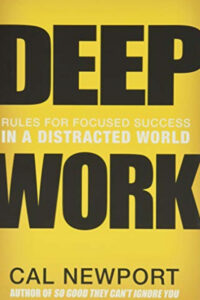
Deep Work: Rules For Focused Success In A Distracted World By Cal Newport
They’re like, “Is this company a scam or not? Are they real? They’re alive. They’re posting once a week that.” I’ve been selling that a lot. It’s once a week and then spend that extra money on ad spend with Google or Facebook to get more bang for your buck and more conversions. I’m downplaying my historic business because when I started, it was way more posting. As organic reach has declined, I’m like, “Don’t post nearly as much. Spend it on the ad platform. Save your money.”
Once you sit down with a client and identify whether it’s the budget, a target audience, what they have been doing and what’s working and not working, then you would put together some custom posts that might elicit more clicks, awareness or whatever that may be.
How do we make the cash register ring for you? I care about dollars. People talk about branding and sharing of mind. I don’t care. Are you making money or not? That’s all that matters. Let’s figure that out. I’ll give you an example with Facebook Ads, for instance. Let’s say I was trying to sell this nootropic. The first thing I would do is we’re going to test the product. Maybe you’ve got twenty products. We’re going to test the products and see which one to focus on because I want to focus on your bestseller.
I don’t want to focus on all of them at once. I’m going to test the product and then the copy. Let me come up with 5 to 10 different angles of the actual writing of the ad to see what’s going to work. Once we find the best product and copy, then I’m going to test the creative. I’m going to throw ten different creatives out there in a video or a plain white screen where the product is big. You never know what’s going to work.
For instance, in the Super Bowl, one of the highest-performing ads was a QR code floating around. Who would have thought of that? You got to throw stuff out and see what happens. Once I’ve got the best product, copy and creative, then I’m going to start testing audiences on Facebook. We will say, “Is it entrepreneurs, VPs, business owners or college students?” We’re going to find those, get a bunch of conversions and then start opening it up and selling more of your stuff. It’s testing and science experiments on repeat.
That supports exactly what you said and most of us know it. You’re putting all this content out there. You’re not getting a lot of results. You’re getting some likes or friends, but there’s no substance to any of it.
The first step is always setting up proper tracking. I have a client. I’m not going to say who it is. They spent $50,000 with no tracking setup. They had no idea if it was working. He’s like, “I’m afraid to turn it off. I don’t know if it’s working or not.” We have determined that it was working somewhat all of that time. It was $50,000. They had no idea if it was working. You don’t want to do that. The first step is always proper tracking and attribution.
That’s good advice. I hope, Charging Forward Crew, you took a lot of notes during this interview. Like, subscribe, check us out on iTunes and leave us a review. Please look up Isaac Mathews and Growing Pains Marketing and get more information on his company. He’s amazing. He has done a lot of great things. Isaac, is there anything specific or any specific place that these folks can go to find you if they want to learn more about your company?
My website GrowingPainsMarketing.com is the best place. There’s another good tip. Don’t obsess over the name too much. I came up with that over the weekend. It doesn’t matter that much. My wife came up with it.
It’s a pretty cool name. I was wondering where you got that name.
I came up with something cheesy and my wife talks to me down to Growing Pains Marketing. I was like, “That’s cool.” I always thought about changing it, but I never have. We will see.
Isaac, thank you so much. Charging Forward Crew, thank you so much. We will see you next time.
Important Links
- GrowingPainsMarketing.com
- So Good They Can’t Ignore You
- Good to Great
- Built to Last
- Deep Work
- Slack
- iTunes – Charging Forward
- https://www.Instagram.com/IsaacRyanMathews/
About Isaac Mathews
 Isaac owns a social media agency that has worked with over 150 brands. He grew the agency to multiple 6 figures before quitting his 9-5, and now he spends all day figuring out how to help small business owners utilize social media as efficiently as possible.
Ready to plan your early retirement?
It all starts with passive
income. Apply to join
the Sterling Rhino
Capital Investor Club.
Already working with us?
Welcome back.