

Running The Race To Multifamily Real Estate Success With Jonathan Nichols
Getting into multifamily real estate requires mindset and the drive to succeed. You have to be ready to grind and stay consistent to achieve your goal of financial independence. Chris D. Roberts charges forward with CEO and investor Jonathan Nichols as they talk all about multifamily. Jonathan discusses how he entered the space, what he learned about the cost of success, and what drives him to his goal. Honest and informative, this episode is for people who want to enter the real estate business.
—
Listen to the podcast here
Running The Race To Multifamily Real Estate Success With Jonathan Nichols
We are here with an amazing guest, Jonathan Nichols.
Thanks for having me, Chris. I’m excited to be here.
We call our readers The Crew. They are a part of our group. They read, learn, have fun, and send us comments. It’s a good time. You will hear me refer to our group here as Charging Forward Crew as we go along. Let me ask you this question. How do you define or what is your idea of success? Some people use success as a driver by thinking about building wealth or businesses. That’s not always the case but we all have a different definition of it. How do you define success in your life?
It goes back to your why. Why are you doing this? When you think about entrepreneurship or multifamily, you quickly come to realize how much effort goes into it. If you don’t have a strong why or something to push you towards what you define as success, you are never going to get there. For me, I don’t know if I’m unique in this but I have several different reasons or whys behind this.
Like everyone, I want to build financial independence for my family. When my wife and I first started investing in real estate, I saw how it drastically changed our financial trajectory. I wanted to build off of that to other people. That’s a big reason that I decided to jump into multifamily and offer syndication investment opportunities.
I want to have an impact on my community, tenants, and the people around me. I have a lot of different whys but I have summed it up into one term, which is running the race well. I have been an avid runner and triathlete for many years now. It’s what I love to do outside of work. If you think about it, life is a lot a race. You only get one chance.
There are no timeouts and do-overs. You are in the race and running it. My goal is one day, whenever my life is over, I want to say that I have run the race well and done the best I can for my family, friends, those around me, and truly made an impact. To me, that’s what success is and my why behind pursuing multifamily and entrepreneurship.
If you don’t have a strong why, if you don’t have something to push you towards what you define as success, you’re never going to get there.
I like what you said about running the race well. I have said sometimes to people to challenge ourselves. You have your wonder wall back there, and I have a wonder wall, which is all my mountain climbing pictures. I had them all put on canvas, all the volcanoes I have climbed. They are right outside my office. The reason I say that is because I’m looking at your wall, and I’m inspired to see ribbons and pictures of the events. That’s cool.
You draw from those experiences and remember how much you were challenged when you were in those events, which brings you back to the center when you are focused on acquiring a multifamily deal or whatever you are working on at the time. What I love about what you said there is that you are using that as a driver. Those challenges help you to overcome the challenges in your everyday life. I have said to people, “Have you ever run a mile as fast as you can to see how fast you can run it?”
Not because someone told you that you had to run a mile or had to qualify for a test. I had to do that once. I ran 1.5 miles as fast as I could to qualify but I didn’t run it to qualify. I’m not a runner. Out of 50 people, I took 2nd place. That was a huge accomplishment because I’m not a runner. You could say the same thing. You have run all these races, and there have been instances where you were fighting for yourself. You didn’t give up and didn’t quit when you got 2nd, 1st or 3rd. You ran until the very last second until there was no gas left.
It’s such a great point, both about running and about entrepreneurship in general. It’s something that might seem obvious when I say it but people may not have thought it through. You are doing it for yourself. It’s not about someone else. I’m not an Olympic runner. Quite frankly, I never will be but I still go out and do my best.
I have had success in some races. Am I ever going to be the Grant Cardone in multifamily? I’m not going to limit myself but at the same time, even if I never am, I’m going to go out and do my best and make the most of it. There’s a lot to be said about that. We can use people around us to motivate us and drive us forward. If it becomes a comparison, it gets dangerous pretty quickly.
You mentioned Grant Cardone. The guy is amazing. There are a lot of people out there that inspire us. They have all these deals and businesses but at the end of the day, it’s not about someone else’s definition of success. It’s not about what we perceive as success. It’s how we feel and what drives us every day because, to your point about your why, what’s going to keep you going when you don’t hit that level of achievement or success?
You have to have your definition that is more attainable to you, and then you are going to keep reinventing yourself. I’m asked the question oftentimes about goals, “What’s your goal, Chris?” I’m always reinventing my goals. They are always shifting. If I have a goal and I hit it, it’s over. I’m done. That’s not what entrepreneurs do. We keep going.
I had to think about it even long before I started multifamily when my wife and I first started real estate in general. We were educating ourselves on it because we didn’t have real estate backgrounds. We are listening to a podcast, and someone had said their why was when they were on their death bed one day. They didn’t want to look back on their lives and wonder what they could have done. That stuck with me. I don’t want to look back on my life and say, “I didn’t try. I wish I would have tried this.” For me, it’s about getting the most out of myself and doing the best I can do.

Multifamily Real Estate: We can use people around us to motivate us to drive us forward. But if it becomes a comparison, it gets dangerous pretty quickly.
It’s great that you have found that place that can keep you fired up, inspired, and moving forward all the time. It’s tough being an entrepreneur or being a business owner, especially coming out of a corporate environment. I know quite a bit about you but the Charging Forward Crew doesn’t. Why don’t you start wherever you want to start and tell us about yourself? Take us down your journey and how you left your engineering career at some point. You’ve got into single-families, multifamilies, and who knows what else. Tell us a little about you and help us understand your path to your definition of success.
I worked for eight years after I graduated college as an Aerospace Engineer. That’s what I studied in school. Specifically, I worked in propulsion, so all things engines on helicopters. I did design and flight tests where we went to all different kinds of places or environments and flew helicopters in adverse conditions. It was a pretty cool career by most people’s standards. I have a lot of great memories from it. One thing that always confused me was I always felt like there was this lid on my career. No matter how hard I worked, I was only going to advance and do so much in the corporate world.
There was always this internal hunger there to do something more. I’m a very avid reader. One day, I happened to pick up the book Rich Dad Poor Dad. That’s when it clicked, “There is more out there. This hunger that I have is this.” If you have read the book, it doesn’t tell you how to do anything. It’s a why book. It gives your mindset the shift you need to start thinking about what you want to do.
Once you know that, it’s pretty easy to figure out how to do it. I read that book, and my wife and I started talking about it. We are like, “We don’t want to be this Millennial generation without pensions, with a little 401(k).” We worked our butts off, and 30 years from now, we have nothing to show for it. We want to do well.
We started learning about real estate. Shortly thereafter, we bought our first investment, a fourplex property right across from the AT&T Stadium. What’s interesting about that project is it didn’t start there. We house hacked it and moved there. It’s because there was so much deferred maintenance on it, instead of cashflowing a few hundred dollars a month, and thought we were going to, we are paying a couple hundred a month to live there because of how much maintenance activity there was on that property. We thought, “This is not what we were expecting. What can we do?”
Real estate is an appreciating hard asset that has inherent value because of its income-generating capability.
We had done a little bit with Airbnb in the past with short-term rentals. We wound up converting all the units to short-term rentals. We went from negative cashflow and a couple of hundred to positive cashflowing $3,000 a month. That was pretty cool. From there, we said, “Now we need to scale.” We started buying one property, another property, and other property. We started doing it but even still, we are like, “This is tough to scale. This is a hard business to keep growing massively.” That’s when we started to learn about multifamily.
It has been years where we are like, “Maybe multifamily is the direction that we need to go.” We started learning and spent the better part of 3/4s upwards of a year learning. We recognized that syndication was the path we were going to take, and if we were going to be accepting other people’s money into a project, we were going to have to be very serious. We couldn’t have another fourplex type scenario when doing a project with other people’s money.
We spent half a year learning on our own. We then jumped into a mentorship program, which you are very familiar with, Michael Blank Mentorship Program to get that extra bit of coaching and over the shoulder help. At the beginning of the year, we were able to do our first syndication, a co-GP on 100 units in the Tulsa, Oklahoma market. We then went on and did a joint venture project on small multifamily here in Arlington that we converted to short-term rentals, and it’s doing very well.
At the end of the year, we closed on a 75-unit in College Station, Texas. It’s a nice Class A property, only 7 or 8 years old but it’s a management play. The previous owners were mom-and-pop. They didn’t have a website and advertise for the property. They did the bare minimum upkeep. By incorporating professional management and marketing, we were able to drastically increase the rent on that property. We are starting 2022, have new goals set, and working on a new project. That’s the short and sweet summary of who we are and where we are going.
You and your wife, Paula, have this life. You are trudging along, working, and you read this book. This book changes your paradigm. It changes your way of thinking and the way you see the world. Not unlike a lot of people that go to an event, maybe a Tony Robbins event or someone comes into their life that inspires them. I had similar experiences but with someone that came into my life that changed my way of thinking. There are a lot of things that go on in our lives but it takes something to trigger that action.
You said, “Once we read the book, we’ve got to thinking about how we didn’t want to be Millennials that had nothing when we’ve got older. We are not focused on the important things in life. We wanted a better life for our family.” When you made that shift, it’s not easy to read a book and then go buy a property. Would you mind talking us through it? You read the book. How did you save and buy it? Talk us through that scenario. What happened there?
There was always this internal hunger within me. For my wife, Paula, she came here to the United States from Columbia when she was thirteen years old. She has a pretty traditional immigrant story that’s very inspiring. One thing you see amongst a lot of immigrant stories like that is people who have a hunger to do well. Together, we both knew we wanted to do something. It’s just, “What is that?” I don’t think we knew what was possible.
First, it was reading Rich Dad Poor Dad, and that mindset shift, “There are other things out there.” In Rich Dad Poor Dad, they talk about real estate, gold, and buying notes. There’s no specific, “Go do this.” The question is, “How did we land on real estate?” It’s a couple of things. My wife is a Finance major. She understands numbers, accounting, and stuff like that really well. I’m an engineer, so I understand analysis.
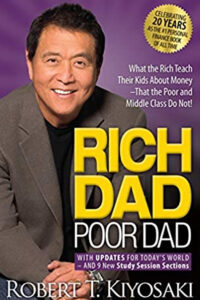
Rich Dad Poor Dad: What the Rich Teach Their Kids About Money That the Poor and Middle Class Do Not!
Real estate is something that you can analyze. It’s something you can study and look at. I’m not saying that you can’t do that with the stock market or other investments. Certainly, you can but it’s extremely tangible. I liked the idea of buying something that was a hard asset. It’s not going to go anywhere. If the economy crashes tomorrow, my stock market portfolio could be cut in half. Fortunately, that’s pretty minimal now but my real estate portfolio is not going to be cut in half.
Could rents go down a little bit? They could. Could property values dip a little bit? They could. At the end of the day, real estate is an appreciating hard asset that has inherent value because of its income-generating capability. That’s what settled us in on the real estate world. I already talked about how we started with residential and then transitioned to a short-term rental due to the cashflow and eventually multifamily. Part of the crew is familiar with the benefits of commercial real estate in terms of how it’s valued and your ability to force appreciation. It was the next step in the journey of thinking through what’s the best asset class for us.
One thing that’s interesting about multifamily is that you don’t have to be that smart to be a multifamily syndicator. If I go start a business selling some new gadgets that I invent, I have a very hard road ahead of me because all the blueprints, systems, and the things that have to work together, I have to develop all of those. With multifamily, there are very proven and well-defined blueprints out there for how you can achieve success. If you buy a multifamily property, there are very well-defined systems that you can use to run it efficiently.
In terms of someone from a non-business background in the past being able to jump in and perform well, it does come down to desire. It’s less about knowledge or this gambling. It is much like working hard and being willing to commit yourself to learn about that blueprint and the systems that go into a successful real estate business. I know that’s a smorgasbord of answers but they all played into our reason behind eventually going into the multifamily space.
I will ask a specific question to bring us back to your first deal. That makes perfect sense, and I can see how you drew on the strengths of both of your experiences to help you get to the next level and scale. We have a lot of folks that are looking to get into the space. Maybe they are looking to buy their first rental property. Many folks that get into multifamily start with single-family flips, land or house hacking. Can you tell us briefly about that first opportunity that you did? You could summarize it like, “We house hacked, lived in one side, and sold it. We refied, got equity out, and scaled.” Talk us through that because you had the smarts.
You had a partnership within each other that helped you to handle the single-family challenges or duplexes because those are much easier to deal with than 100 or 200 units when you have property managers, attorneys, and syndications. Give us a summary of that process, and we can talk briefly about your multifamily space. This is where we transition there because you joined a mentor program and things of that sort. For the person reading who hasn’t done anything with real estate, what would they do to do what you did?
The four-step process of dream, learn, network and, execute is what it takes to get started and to keep moving forward on each step of the journey.
My wife and I went to a local real estate meetup when we first started learning about real estate, totally newbies a few years back. We’ve got to present at that meetup, starting to kick off this year, which was cool to come full circle. When you are talking about first, getting into real estate, you need to listen to podcasts, educate yourself, etc. A lot of it is jumping in and taking action. I’m sure that someone who did a perfect analysis of our first four units would have found some flaw with it and a reason that we should not have bought it.
I remember when we’ve got the courage to pull the trigger on that property, primarily due to someone who was our realtor in that transaction, who encouraged and pushed us along the way, going to sleep that night and had a nice house that I had lived in before then. I did not need to move away from my nice house and being like, “If we can make it through this, we will be successful in real estate. We will make it.”
You start with that level of educating the desire, and then you go onto the level of education. You find a network of people that are going to help you, and then ultimately, you have to pull the trigger and do something. That four-step process, the dream, learn, network, and execute, is what it takes to get started and keep moving forward on each step of the journey.
Charging Forward Crew, I want you to take away from that something important that he said, which was, “I went to a meetup and presented. We had an opportunity to get out there and test our knowledge to build our confidence. It’s not about reading books. It’s about getting outside your comfort zone.” It’s doing things that you think you are going to fail at. It’s no different than running a marathon for the first time. We talked about running a little bit. You have to push and challenge yourself, and good things come from that.
One of the first meetups that I ever did, I had investors come out of that. It was one of the first meetups that I presented at. I’m talking about syndications when I first started. I didn’t know near what a lot of the folks around me knew, yet people had enough confidence to invest in opportunities with me, which was huge because I would never have thought that. I thought, “I’m going to go there and talk to people.” You don’t know. You may be the expert in the room on your specific topic.
Not everybody has read Rich Dad Poor Dad or looking to house hack. You get up and start talking about it. All of a sudden, someone says, “This person knows a lot.” Maybe they throw a few thousand dollars into your opportunity so they can then learn and make some returns as well. That’s cool that you did that and took that initiative to go out and take action.
The key missing link in most of this stuff is tons of great education. You touched on Michael Blank’s mentor programs. There are all these other great teachers and seminars out there as well. If you live at those events, don’t take action, get yourself out there, and get uncomfortable, you are not going to get anywhere.

Multifamily Real Estate: A lot of people want to talk about the risks of doing something, but they never talk about the risk of not doing something.
Let me take that one step further. One other story we told in that presentation was we moved to our fourplex house. It was the normal, modest-sized, 1,300 square foot house in Arlington. We rented that house out. The tenant who came in was a perfect tenant. You can never find a better tenant like that. He had a very high-paying job and was very well-educated.
He told me when he signed the lease, “I’m interested in investing in real estate. I have learned a lot about it but I’m going to wait until the market cools off a little bit before I buy.” He stayed with us for a total of two and a half years. We only cash flowed $4,000 or $5,000 on the property throughout that year but we paid down $10,000 or $12,000 on our note. The property appreciated $60,000.
That’s the price you pay when you don’t take action. That’s what it comes down to. A lot of people want to talk about the risks of doing something but they never talk about the risk of not doing something. The purpose of that story is to say that you have to look at both sides of the equation, “There is a risk if I go buy this property but there’s also a risk if I don’t.”
You better write that down if you didn’t write that down, “People talk about the risks of doing something but not about the risk of not doing something.” I have heard something similar to that but it wasn’t phrased that way. I liked that. Even if you live with that in your head, it will help you to overcome a lot of those voices that are telling you, “You can’t do that. What if you fail? What if you lose some money?”
There’s a lot more to that. You can’t go and put it all on black and risk losing it all. You have to still have your emergency funds and be conservative to a certain extent, maybe have 1 or 2 sources of income. We need to quit focusing on all that stuff and focus on what happens if we don’t try. Let me ask you this. What are or who are some of the influences in your life? It could be a person or a book. What do you lean on when you start to get down or find yourself drifting, and you need something to get you back into that inspirational mindset?
There are a lot of answers I can give to that. First of all, my wife and I are people of faith. God is an important part of our lives. One of the principles we live by is loving your neighbor, helping those around you, and being willing to look out for other people’s interests, not your own. That’s a big influence on how we do business, communicate, and do projects. That’s something I have to mention to start out with.
Beyond that specific individuals, I can’t say that there’s one person for me but there are a lot of people who made little advances. I mentioned we worked with a realtor on that fourplex. Before we bought that, we were thinking about buying a single-family home, putting 20% down. She’s like, “You are looking at this the wrong way. Go move to the property where you only have to put 3% to 5% down and go as big as you can, make the most out of your opportunity to use a primary residence mortgage.” She pushed us there. That’s one individual I’m thankful for. We had another individual who’s a multifamily syndicator within our group. I hate to say it but many people raised their hand, and they are like, “I’m going to go into multifamily,” and three years down the road, nothing has happened.
Love your neighbor, help those around you and be willing to look out for other people’s interests, not just your own.
Back when we were those people who had done nothing in multifamily and owned a couple of properties, there was an individual who was a multifamily syndicator in our group who was willing to sit down and meet with us, not once but multiple times, and answer all the crazy questions we had and encourage us. We are very appreciative of him. He was one of our partners on our deal that we found and closed. That was cool getting to do a deal with him a couple of years later. Those are more mentor-type people. It’s important to mention your peers.
We have a number of partners on our deals, all outstanding people. Many of them, we partnered on multiple deals with. It’s amazing to me how much they encourage and push you forward. Each of us has our own moments of strengths and times of weaknesses. Having people surrounding you, encouraging you, looking over the details of what you are thinking or the numbers, and giving their honest opinion should not be undervalued.
You want to find people who are competent. That’s a peer group. Those are the people like you that are moving forward. That value can go back and forth both ways. That’s a couple of different groups there. I could ramble on for a while about everyone that has played into our story but there are a few right off the bat.
Oftentimes, people will reference a book. We know as entrepreneurs that it takes an awful lot of positive influences to stay on track. I go out and run if I’m stressed. It feels good with your body, the chemical reaction, and the blood flow. I like jazz music. When I’m grinding on spreadsheets, I will put jazz in the office. It’s the opposite of my personality. I’m generally on fire. That grounds me. It allows me to focus and be calm.
Let’s say you hop on the phone with somebody who is a positive influence in your life. You are jamming for 30 minutes, going back and forth. It’s critically important. I want to go back to this real quick something you said, which was, “I have this individual who spent some time with me.” Everyone’s time is valuable, as is yours. You would not generally get the time of others that are a little more advanced in where you want to be as far as a career unless you showed them that you were worthy of that time.
The reason I’m highlighting this is there must have been something in your personality that gave that individual the confidence to spend time with you, and then you demonstrated most likely that you were more worthy of that time. That person will perhaps not even charge you for it, “I’m going to spend more time with these guys because I see they’ve got the passion, enthusiasm, energy, and they are going go out and change their community or their family’s lives.”
That’s important because oftentimes, people are reaching out, not just to me but to others, and trying to learn as much as they can. At the same time, they are not putting in the work. They are asking questions and are not applying. You are talking and seeing them again at another event. You are like, “I’ve got 500 units.” “What are you doing? I still haven’t done my first deal.” It’s like, “Why not?” It’s so important.
It’s important to mention that why not or what keeps people from doing that first deal. Another thing we talked about in that presentation with our first multifamily deal, which to put it in perspective, was eighteen months between when we said, “We would like to do multifamily.” We were signing on the line to close that first deal. There were some people in the meetup who laughed because they didn’t think that sounded that long.
When you are grinding, eighteen months in a long time, let’s face it, especially when you are 13 or 14 months in, and you don’t have an end in sight, you are continuing to have faith that eventually, this is going to pay off. You have to work hard and be consistent. There is a level of luck in defining deals, especially in this market. A lot of it that I encourage your people to think about, “Where can you bring value?” For me, I assumed that my value was going to be finding a deal. The reason was I had run numbers on single-family deals at a small scale, and I was an engineer. I was going to be the numbers person.
What I have learned since then is that any savvy multifamily investor can run an analysis on a deal and see if it’s a good deal or not. Some people are a little better than others but in general, it’s not a highly valued skill. Finding deals and having relationships with brokers where you can get a good deal is a valuable skill. The problem is you are almost never going to build and develop those until you have done a deal or two. It becomes the chicken and egg thing.
The question is, “How do you break through that barrier? How do you get to that first deal?” There are a lot of answers you could give but for us, and what I recommend for most people, is to get to the point where you can raise $500,000 for a deal. For a lot of syndicators who are doing their 2nd, 3rd or 4th deal, the raise is the most challenging part of it after you find the deal. Being able to confidently tell someone, “I can bring in 1/3 or 1/4 of the money that you need to close on this deal,” is a level of value.
On our deal, because we had done some rehabs and our partners lived out of the country, we were able to do the due diligence, the walkthroughs, and some of that boots on the ground stuff for the property too. That’s how we were able to add value on our first deal where we were co-GPs. After that, brokers start talking to me and sending real off-market deals. It’s that one thing that’s determining, “What’s the one thing that’s hindering me from getting to my goal and plugging away at that until I get it solved?” That may not be the only way to get into your first multifamily deal but it’s one great way that you can.

Multifamily Real Estate: Finding deals, having relationships with brokers where you can get a good deal, is a valuable skill. The problem is you’re almost never going to build and develop those until you’ve done a deal or two.
You know what you do, and you have put in the work. You have ground it out, and you are having great success now. What I love about what you said is that you shifted. You have this experience. You have a number and an analytical person. You realized quickly that those might not be enough, so we have to pivot and be a relationship person. We’ve got to build a relationship with these brokers. We are learning that but then how do we do that?
You raise capital and jump in on someone else’s deal or you partner with others, with your mentor, whatever it may be. Now you are showing you have the ability because, in the single-family space, if you raise $500,000 dollars, you could buy a lot of properties. When you are in multifamily, the game changes but that’s good because you are bringing value as a partner. That helped you to propel and get to where you are. I love what you said about that.
The reason for that is that I hear many people talk about broker relationships or finding the deal. We focused on capital right out of the gate, a lot. That opened up lots of opportunities for us, and that’s how we grew and scaled quickly. That’s good advice, Jonathan. Tell the Charging Forward Crew how we can find you, what is the place you want to send them or a giveaway. Share with us how we can learn more about you.
First of all, a little bit about what I’m doing in 2022. I live here in Dallas. Even though I raise money now, I love finding deals. Now that I’m a full-time investor, I look at a bunch of deals, particularly here in Dallas and Oklahoma markets. I am very attuned to the properties being sold, what’s going on, know a lot of the brokers, and continuously working on progressing in those areas. As far as what we are doing, we are looking for solid value add multifamily deals in Texas and Oklahoma markets.
As far as reaching out and contacting us, we do have a website. It’s www.ApogeeMFC.com. On there, we have a lot of different resources. We have a blog that I write each week. It’s oriented towards passive investors and educating you. It’s easy to read. We also have a free eBook that’s an overview of what passive investing is.
Work hard, be consistent and look for where you can bring value.
Anyone who’s like, “I’m interested in investing in real estate but I don’t know if I want to quit my job or go full-time,” that could be a great resource and opportunity for you. I’m very active on LinkedIn. I’m sure you can find me on there, @JonathanNichols. If you want to chat about deals or investing, I’m always happy to entertain a conversation. Those are the two best ways to get ahold of me.
Thank you, Jonathan. I appreciate you sharing your and Paula’s journey through this space. It’s always intriguing to know, especially folks who come from countries that push them to want more than where they are coming from and drive them to have a little bit more in life. I have talked to so many people that have come from other places, and there’s an appreciation. There’s a fire and enthusiasm that comes from living in that space, in that world, in another country. It’s not appreciated by a lot of people.
Unless you have been there, you can’t truly understand it, even if you read it. Not to say that that where she came from was that bad, whether it’s Mexico, Peru or Europe, wherever you are coming from, it seems a lot of folks come to the US, and they thrive in that entrepreneurial space because there’s this passion and enthusiasm in them. I know so many folks like that. It’s awesome.
There’s a great book. It’s by a guy named Brian Buffini. A lot of the crew may have heard of him. He’s a very big real estate guy out in San Diego, California. He was an immigrant from Ireland when he was 19 and had $80 in his pocket. He highlights some of those lessons that he learned. It’s an easy and fun read. It’s called The Emigrant Edge. I would recommend it for anyone that wants to explore more about what that mindset looks like and how it can help you be successful.
Thank you for sharing that. I’m sure the journey and the experiences you have shared have been amazing and helped propel you to the success you have. Thank you so much for that.
—
We just finished another great interview with Jonathan Nichols. Here are two of the takeaways. One of them was how he talked about the Rich Dad Poor Dad book. If you haven’t heard of that book, you must read it. It’s a great book about financial literacy and storytelling. He used that book to change the trajectory of his and his wife’s financial future. He and his wife, Paula, decided after reading that book that they needed to focus on investing in real estate. They bought their first house hack, which is buying a duplex and living on one side while you rent the other side.
From there, they started going to meetups, built their confidence, and then eventually hired a mentor that led them down the path to building a multifamily real estate investment company. Jonathan has left his full-time career as an engineer and is a full-time real estate investor. Kudos to Jonathan and Paula because it’s not easy to do.
The second thing was a quote that he tossed out, “People focus too much on the risk of doing something and don’t focus on the risk of not doing something.” I loved the way he articulated that. It went full circle back to what we were talking about how he uses running to inspire him as well as full of these pictures of him running at different events.
There are a lot of us that have doubts and fear. We focus a lot on the what ifs. We focus a lot on, “What if I fail? What if I get judged? What if I lose a couple of dollars here and there?” That holds us back from achieving our dreams. I thought that quote was cool and told how he sees his business and focuses on a growth mindset versus failure, which is easy to drug into. Those are two of the takeaways. You want to read more of the details of the interview. It was a great conversation, a lot of fun of back and forth. I hope you enjoyed it. We look forward to seeing you there.
Important Links:
- Jonathan Nichols
- Rich Dad Poor Dad
- Michael Blank Mentorship Program
- @JonathanNichols – LinkedIn
- The Emigrant Edge
About Jonathan Nichols
 Jonathan Nicholsis a real estate investor local to the DFW metroplex. He began his REI career after having worked for almost ten years in the aerospace engineering industry as a propulsion engineer where he analyzed and integrated turboshaft engines on helicopter platforms.
He holds a B.S. degree and a M.S. degree in Aerospace Engineering from Texas A&M and Virginia Polytechnical Institute respectively. He and his wife Paula first began their investing journey in 2018 and have undertaken numerous different types of projects before forming their multifamily investing company Apogee Capital in 2020.
His past real estate projects include a 75-unit A class apartment complex in College Station, TX as a GP, a 100-unit complex in the Tulsa MSA as a GP, an 8-unit apartment to STR conversation in Arlington, TX as a GP and 200+ units investing as an LP. Additionally, he has numerous residential real estate investments and a top rated short-term rental business in the Arlington Entertainment District. Known as a person with a high work ethic, Jonathan enjoys helping others to achieve their goals (financial or otherwise). Outside of work, he enjoys spending his time racing in Ironman triathlons and traveling with his wife.
Ready to plan your early retirement?
It all starts with passive
income. Apply to join
the Sterling Rhino
Capital Investor Club.
Already working with us?
Welcome back.